Michael A. Turton
 Heading south on Taiwan's major highway, just outside of Taichung. The recent addition of a third lane has been highly beneficial for local blood pressures.
Note: the previous version of this page is here
|
Michael A. Turton |
Heading south on Taiwan's major highway, just outside of Taichung. The recent addition of a third lane has been highly beneficial for local blood pressures. |
| Driving in Taiwan Note: the previous version of this page is here |
|
| Introduction | Surviving on Taiwanese Streets | Highway Driving | Licenses and Vehicle Ownership | Scams and Safety | Road Navigation |
| Consequently, driving in Taiwan is an inconvenient, stressful, and even dangerous act. |  If the police tow your vehicle, they will indicate where they have taken it and the phone number of the holding lot. You won't be able to retrieve your vehicle without paying the fine. If the police tow your vehicle, they will indicate where they have taken it and the phone number of the holding lot. You won't be able to retrieve your vehicle without paying the fine. |
| The biggest problem in Taiwanese driving is the omnipresence of scooters. They generally ignore traffic laws, safety, and the convenience of other drivers, and if you hit them, they always claim it is your fault regardless of the situation. When you first start driving here, pay close attention to them, because they will not pay attention to you. |  Scooters leaving before the light has changed encounter a vehicle making a left turn by running the red light (note the green light). Such situations are common, and you will soon learn that it is unsafe to enter intersections rapidly when the light changes. Scooters leaving before the light has changed encounter a vehicle making a left turn by running the red light (note the green light). Such situations are common, and you will soon learn that it is unsafe to enter intersections rapidly when the light changes. |
| Hardly a day goes by when I don't see an accident of some kind. Be paranoid, not just careful. | 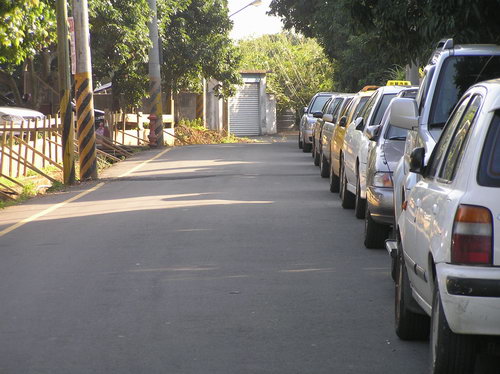 Cars parked on a mountain road as their owners go hiking. Cars parked on a mountain road as their owners go hiking. |
|
A friend of mine who has been here 14 years distilled the basic principle of driving here into a single pithy sentence:
You are responsible for what is in front of you. |
 Policemen respond to an accident during rush hour. Policemen respond to an accident during rush hour. |
| Introduction | Surviving on Taiwanese Streets | Highway Driving | Licenses and Vehicle Ownership | Scams and Safety | Road Navigation |
 A stirring view of the plain south of Taichung bordered by the mountains on the east, as seen from the new North-South Highway . A stirring view of the plain south of Taichung bordered by the mountains on the east, as seen from the new North-South Highway . |
 A cycle pulls out in front of cars on a suburban street. Can you see the second cyclist preparing to enter the road? A cycle pulls out in front of cars on a suburban street. Can you see the second cyclist preparing to enter the road? |
Traffic laws in Taiwan are pretty much the same as in the US. The most important difference is that there is no right on red unless indicated by light or policeman.
However, most scooter drivers pay no attention to this law. |
 A highway rest stop information booth, staffed by the same bored by helpful personnel the world over. On the left is an advertisement for the second floor restaurant. A highway rest stop information booth, staffed by the same bored by helpful personnel the world over. On the left is an advertisement for the second floor restaurant. |
Remember to always check both mirrors when you turn. Taiwanese will cheerfully pass left turning vehicles on the left, and right turning vehicles on the right.
To date two idiots on scooters have hit me on the left as I was making a legal left turn. Both blamed me.
|
 Traffic laws? What are those? Who says I can't pass in the opposite lane on a double yellow on the most crowded day of the year in Kenting? As for those motorcycles, they can kiss my accelerator! Traffic laws? What are those? Who says I can't pass in the opposite lane on a double yellow on the most crowded day of the year in Kenting? As for those motorcycles, they can kiss my accelerator! |
Huge difference in customs: when a car flashes its lights at you, it means: "I'm coming through" not "please go first" as in the States.
The speed limit on all city streets is 50 kph except where otherwise indicated. |
 Parking lots and public parks line many of Taipei's rivers. Threatened by flooding, the land has few potential uses. Parking lots and public parks line many of Taipei's rivers. Threatened by flooding, the land has few potential uses. |
|
If you are the first vehicle in line when the light turns green, do not enter the intersection rapidly. Frequently the last vehicles through as the light changes from yellow to red will attempt to run the red light. The accident risk is extremely high for early entrants into the intersection.
|
 The old highway near Tainan, now being widened. The old highway near Tainan, now being widened. |
|
Drive slowly. Accidents are less destructive that way, and you have a higher safety margin. The frequency of red lights obviates any advantage gained by speeding.
|
 The Chungtou highway, connecting Taichung and Nantou, slashes through the rice fields and small factories that typify the Taiwanese countryside. The Chungtou highway, connecting Taichung and Nantou, slashes through the rice fields and small factories that typify the Taiwanese countryside. |
| A word of advice: be careful whom you pass and where you park. Don't yell at, honk at or flip off people on the road, especially if they know your car (if you flip off everyone who drives outrageously you'll soon wear your middle finger to the bone). |  A small local temple. A small local temple. |
|
Look here to read a discussion of this problem on an internet forum:
As I was driving home on Sunday morning some moron cut into the scooter only lane and forced me up onto the sidewalk. I flipped him off. He got out of his car and gave chase to me, he was holding a bat btw. I outran him on my scooter and he proceeded to follow me through Hsin Chuan. I lost him several times but he kept finding me. Now I was at an intersection and he finally caught me. He proceeded to tell me to that he was going to kill me, well that's what I understood. I kept cool because he had a bat. He then struck me in the upper back. A cop showed up and did NOTHING!!! |
 An old woman's recyclable collection slows traffic on a side street. |
|
Encounters with gangsters and ganster wannabes are not uncommon. They drive small late model vehicles with flashing blue lights around the license plates and modified mufflers, or large black cars. Don't mess with them. If they attempt to mess with you, drive away or stop and let them go. Do not confront them.
Foreign skin does not confer immunity to lead pipes, chains, and knives. |
 A side street in a small town in a rural area. A side street in a small town in a rural area. |
| When making a right turn, remember that you will cross the motorcycle lane that runs along the right side of the road. Check your mirror carefully before you turn, and turn slowly. Scooter drivers will not do anything to attract your attention, and they are easy to overlook. |  A rest stop on the Chungshan Highway, the major north-south artery. A rest stop on the Chungshan Highway, the major north-south artery. |
| Again, when making a right turn, check both lanes for oncoming traffic, especially if it is crowded. Taiwanese will drive any direction, any time, especially scooters. For example, it is extremely common for a driver to pull out into the oncoming lane and pass a line of cars waiting for a red light and then make an illegal left or right turn. Scooters will drive in either direction on either side of the street. |  A common problem: this driver has passed a long line of cars waiting at the light by driving up the empty oncoming lane, and is now making an illegal right turn by running a red light. Note the scooter on the corner making a left turn by pulling into the oncoming lane, shooting across the front of the stopped cars, and turning. This dangerous turning method is ignored by the police. A common problem: this driver has passed a long line of cars waiting at the light by driving up the empty oncoming lane, and is now making an illegal right turn by running a red light. Note the scooter on the corner making a left turn by pulling into the oncoming lane, shooting across the front of the stopped cars, and turning. This dangerous turning method is ignored by the police. |
|
Cameras are common both in the cities and small towns, and your picture may be snapped anywhere. The government generally places signs to warn drivers that cameras are watching them.
|
 A camera system on a street in Tali. The camera, the green object in the center of the picture, takes photos of the license plates of speeders. The triangular sign in front warns drivers that the camera is watching them. Adept at evading official regulations, Taiwanese have developed an endless variety of ways to beat the camera system. A camera system on a street in Tali. The camera, the green object in the center of the picture, takes photos of the license plates of speeders. The triangular sign in front warns drivers that the camera is watching them. Adept at evading official regulations, Taiwanese have developed an endless variety of ways to beat the camera system. |
| When getting out of your car, be sure to check the mirror before opening the door, so you don't kill a passing scooter driver by opening the door in his face. |  An expressway in southern Taiwan. An expressway in southern Taiwan. |
| Introduction | Surviving on Taiwanese Streets | Highway Driving | Licenses and Vehicle Ownership | Scams and Safety | Road Navigation |
 Cars cluster at a freeway exit on the new North-South highway. The structure being built is the new High Speed Rail system, an epic boondoggle. Culture may be local, but pork is universal. Cars cluster at a freeway exit on the new North-South highway. The structure being built is the new High Speed Rail system, an epic boondoggle. Culture may be local, but pork is universal. |
 The Chungshan Highway south of Changhua city. The Chungshan Highway south of Changhua city. |
The first major highway, known as the Chungshan Highway, or the First Highway, runs closer to the coast. It is three lanes from Taipei until just past Changhua, when it narrows to two (~kilometer marker 211). The speed limit is 100, but you will be lucky to reach that speed Friday through Sunday on the two-lane section. |
 Customers crowd a rest stop shop along the new north-south highway. Customers crowd a rest stop shop along the new north-south highway. |
A second major north-south highway, formally Highway 3, but always confusingly referred to as "the second southern highway," opened recently. It follows the coast to Taichung, then swings into the foothills, running parallel to the old one, but usually 10-30 kms from it. The speed limit is 110. |
 A provincial highway seen through my windshield. Speed limit on these roads is usually 70 kmph. A provincial highway seen through my windshield. Speed limit on these roads is usually 70 kmph. |
The new highway is three gorgeous lanes of empty tarmac through hills all the way, and wonderful rest stops with 7-11s, Starbucks, and other good places. The Taipei-to-Kaohsiung time is 30-45 minutes longer, however. |
 A rest stop on the new highway. A rest stop on the new highway. |
Speed traps are as sophisticated as in any Western country and both radar and lasers are used. Look for speed traps within 3 or 4 kilometers either way of a toll booth, and under bridges. Also, police cars frequently run their flashing lights while operating a speed trap, so you'll often have warning.
Automatic cameras are also deployed along the highway to catch speeders. They really work, so don't speed. |
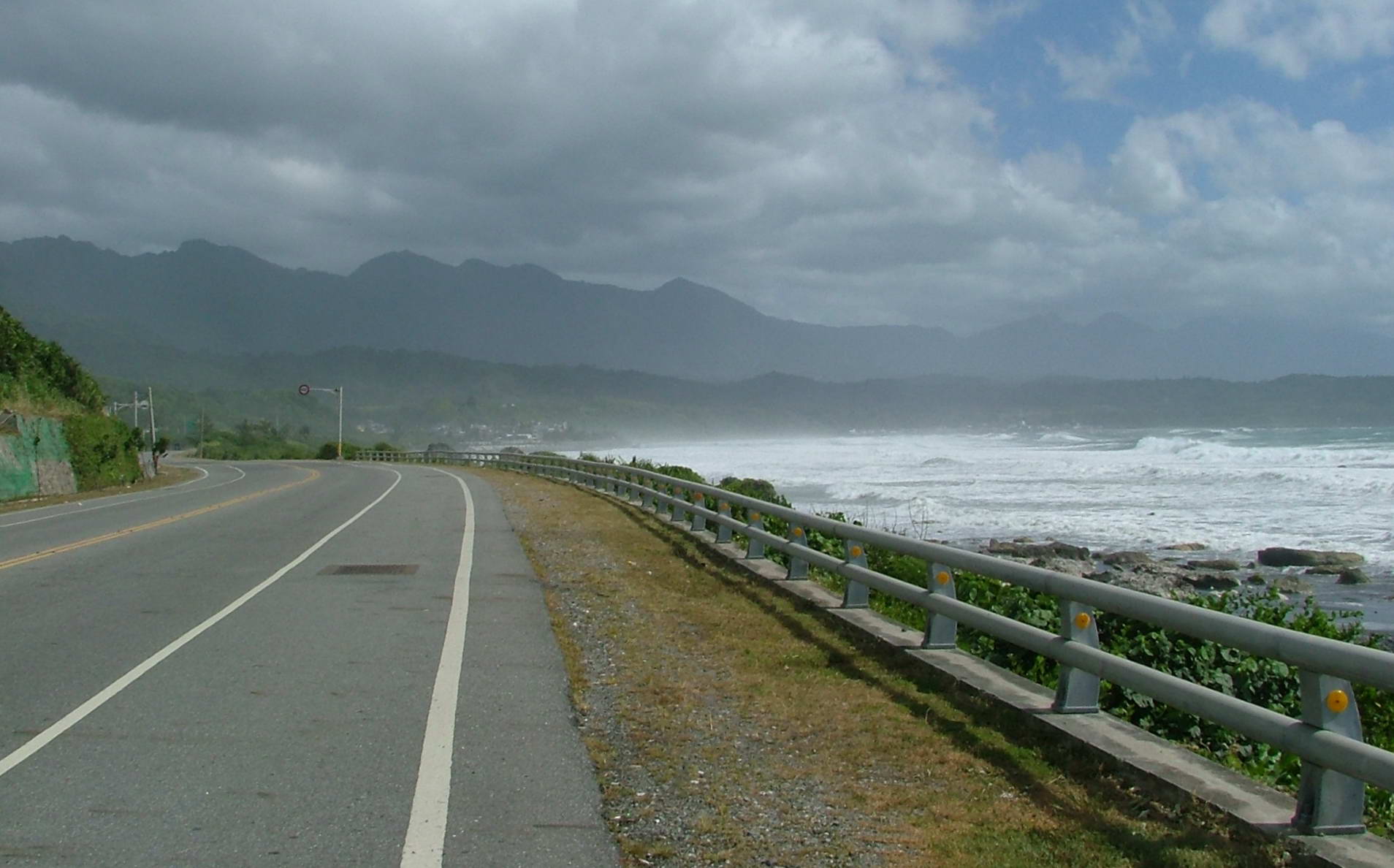 A highway on the east coast. |
|
 The highway is usually pretty clearly marked in English and Chinese. The highway is usually pretty clearly marked in English and Chinese. |
Currently policy gives you 10 kph on the old highway, but only 3 kph on the new. Thus, you will be ticketed at 111 on the old highway, and 114 on the new. |
 The highway near Sanyi. |
The 350 km drive from Kaohsiung to Taipei generally takes 4-5 hours depending on traffic and road destruction......er.... construction. Although major signs are in both English and Chinese, crucial road information such as detours and construction will only be in Chinese. |
 Entering the tollbooth in Taiwan. The blue lane is for those with toll tickets; you can purchase those at most gas stations or at highway rest stops. The cash lane is marked in yellow to the right; passenger vehicles are $40. There are no markings in English, of course. Entering the tollbooth in Taiwan. The blue lane is for those with toll tickets; you can purchase those at most gas stations or at highway rest stops. The cash lane is marked in yellow to the right; passenger vehicles are $40. There are no markings in English, of course. |
Be sure to get in the correct lane at the tollbooths. The yellow lane is for cash, the blue lanes for toll tickets. Entering the wrong lane to pay the toll is an NT$3,000 fine. |
 An entrance ramp in Chungho packed on Chinese New Year, around noon. An entrance ramp in Chungho packed on Chinese New Year, around noon. |
There are two things to be aware of. First, leave early. Highways get crowded after 10:00. Chinese New Year used to be famous for traffic jams that literally extended from one end of the island to another, and travel times from Kaohsiung to Taipei of 16-30 hours. Although the new highways have relieved the crowding, still the traffic is massive.
You can avoid it all by getting out early. |
 A service station at a highway rest stop (Kuanhsi). A service station at a highway rest stop (Kuanhsi). |
Second, do not drive on the new highway after midnight. In many sections of that highway, drivers in search of Darwin Awards drag race in the wee hours at speeds in excess of 200 kph. There was a spate of accidents a while back, and the police finally started to crack down, but the practice continues in more isolated areas (the Toufen-Miaoli-Chingshui section, for example). |
| Introduction | Surviving on Taiwanese Streets | Highway Driving | Licenses and Vehicle Ownership | Scams and Safety | Road Navigation |
 Which way is the right way? Who cares! Madness on a side street in Kaohsiung. Which way is the right way? Who cares! Madness on a side street in Kaohsiung. |
| Quite a few foreigners obtain motorcycles. If you live outside Taipei, it is difficult to live without a scooter. |
 The lovely view from from the rest stop at Kuanhsi in the mountains southwest of Taipei. The lovely view from from the rest stop at Kuanhsi in the mountains southwest of Taipei. |
| A license is required for scooters of different sizes -- 50 CC, 100 CC, 150 CC. Currently an ordinary drivers' license suffices for the 50 CC size. |  A celebratory feast blocks a street. A celebratory feast blocks a street. |
| Many foreigners drive motorcycles without proper licenses, or any at all, as it is common knowledge that the police are less likely to hassle foreigners on scooters, and more likely simply to wave them by. Note that I am not advocating you drive without a license, I merely observe that it is the norm among foreigners. |
 A helmetless woman, with a helmetless son, makes an illegal left turn against a red light. Very common outside of Taipei, where helmet law enforcement is better. |
|
Cars may also be purchased, but it is extremely difficult to obtain a loan unless you are a local. Car loans must also be co-signed by a citizen of Taiwan as well. Better to pay cash, or borrow from Dad.
Vehicles in Taiwan are competently made, but skimpy on the safety equipment and structure. Rear seatbelts are extras in vans. Car salesman are as trustworthy as anywhere. |
 A small town road. The abundance of narrow lanes like this presents serious problems for large vehicles as well as anyone in search of a parking spot. A small town road. The abundance of narrow lanes like this presents serious problems for large vehicles as well as anyone in search of a parking spot. |
|
Currently you must renew your drivers license each time you renew your ARC (work visa). Drivers education centers are found everywhere.
The drivers license situation is idiotic. Most American states do not recognize Taiwanese licenses, so Taiwanese must take a test there. Consquently, most Americans must take the test here There is a written test (impossible to fail) and a road test (impossible to pass). The road test is done in a closed course which is completely unreflective of real-world conditions: it is built so you fail regardless of skill or experience. Nearly everyone fails the first time (this writer included, a most humiliating experience) and most fail more than once.
|
 A betel nut girl waits for a customer. Scantily-clad young women adorn, or desecrate (depending on your point of view) Taiwan's major roads. They sell betel nut, a potent stimulant that has given Taiwan an extremely high rate of cancer. A betel nut girl waits for a customer. Scantily-clad young women adorn, or desecrate (depending on your point of view) Taiwan's major roads. They sell betel nut, a potent stimulant that has given Taiwan an extremely high rate of cancer. |
| The reason it is designed this way is simple: graft. In the old days the road test facility was also the site where driving class takes place. Since the people who teach driving are the same people who administer the test, they make big bucks when you fail and are then forced to register for their classes (welcome to Taiwan: scam island). |
 The Chungchang Expressway that connects the cities of Taichung and Changhua. In the background is the Taichung suburb of Shalu. On secondary expressways like this one, the speed limit is generally 80 kph. The Chungchang Expressway that connects the cities of Taichung and Changhua. In the background is the Taichung suburb of Shalu. On secondary expressways like this one, the speed limit is generally 80 kph. |
| The majority of people register for driving classes so they can practice with the substandard vehicles provided by the test site on the dreaded "S" curve itself, a tight S-shaped curve which must be backed down in one fluid motion -- you are not allowed to stop or go forward. For those of you who are curious, on my second test (which I passed), my friend's friend's brother's friend, who administered the test, said I drove extremely well. |  A drivers ed center behind a parking lot in Yungho outside of Taipei. To the left is the stylized hill for practicing accelerating and braking, to the right is the practice layout. A drivers ed center behind a parking lot in Yungho outside of Taipei. To the left is the stylized hill for practicing accelerating and braking, to the right is the practice layout. |
| Introduction | Surviving on Taiwanese Streets | Highway Driving | Licenses and Vehicle Ownership | Scams and Safety | Road Navigation |
 An alley in Kaohsiung. An alley in Kaohsiung. |
 As a police car watches doing nothing, fourvehicles drive illegally down the left turn lane and then cut in front of the waiting traffic. Perhaps the most important reason the Taiwanese routinely disregard traffic laws is that they are almost never enforced. As a police car watches doing nothing, fourvehicles drive illegally down the left turn lane and then cut in front of the waiting traffic. Perhaps the most important reason the Taiwanese routinely disregard traffic laws is that they are almost never enforced. |
My advice is to pay the money and not inform the police. Even in the highly unlikely event that they find the thief, the punishment for auto theft is light, and the thief knows where you live. I did have an enterprising student who managed to persuade the thief she had deposited the money when in fact she hadn't, and got her car back. Later, though, he contacted her and threatened her, and she was forced to sell the car. |
 Cars advance through the light on a street in Wufeng, a small industrial and warehouse community on the outskirts of Taichung. Cars advance through the light on a street in Wufeng, a small industrial and warehouse community on the outskirts of Taichung. |
A man rear-ends you in a motorcycle, and then claims it is your fault and demands you pay him a small some of money, usually NT$3,000. Violence will be implied or stated. Variation on this: the vehicle taps you, claims it is your fault, and then tries to get you to pay for the damage to the goods in his car. Clever, eh?
Also, motorcycles will lie in wait, ram a car, and then claim the car was running the red light, with "witnesses" in cahoots. This apparently happened to me once. |
 A policeman directs traffic at a crowded intersection, a common sight during morning and evening rush hours. A policeman directs traffic at a crowded intersection, a common sight during morning and evening rush hours. |
In another case I know, a foreign motorcyclist was wounded in a fender-bender badly enough to require skin grafts, yet was hunted down at work and money extorted to pay for the car's damaged side mirror. I have been chased once by a taxi driver who hit my bike, and cornered in a cul-de-sac by irate gangsters, wielding a lead pipe, whose car they thought I had honked at. Not fun. |
 The car we drive, the brilliantly-named "Veryca." A 1.2L engine, seating for seven, and various amenities make this a fabulous buy at around US$11,000 The car we drive, the brilliantly-named "Veryca." A 1.2L engine, seating for seven, and various amenities make this a fabulous buy at around US$11,000 |
I now mount a video camera in the front of the car at all times when driving in the city, and recommend you at least carry one with you at all times. |
 A betel nut girl prepares her goods. Betel nut girls are a common roadside sight. A betel nut girl prepares her goods. Betel nut girls are a common roadside sight. |
In November of 2002 a moron speeding on a scooter ran a red light and nailed the front of my car, leaving me with NT$25,000 in repairs. In addition to the traffic violations, he was also AWOL from his military base. If only I had recorded the whole thing....luckily the physical evidence strongly favored my story. It happened in the idiot's neighborhood and his chums came to help him. They were ruffians, and filled the atmosphere with intimidation and death threats, 90% of it fortunately mere posturing. They also followed my wife home. "Witnesses" magically appeared who said it was I who had run the red light..
Carry a video camera, or at least a still camera, so you can film the area if you are hit. No one will volunteer to be a witness for you. |
 A side street that could be in any Taiwan city; this one is in Kaohsiung. A side street that could be in any Taiwan city; this one is in Kaohsiung. |
|
Parking in areas which someone considers their own is risky (avoid parking in front of someone else's house). Many of my Taiwanese friends have had windows and lights smashed, paint keyed (very common) and so forth when they accidently did that.
Always ask if you park in front of a house or shop. |
 Motorcycles race out into traffic as the light changes on a Kaohsiung city street. The variety of traffic threats on a given street may include vendors pushing carts, pedestrians, bicycles, scooters, cars, vans, delivery trucks and large trucks. It can be bewildering for Americans used to the sedate, empty, well-regulated roads of the USA. Motorcycles race out into traffic as the light changes on a Kaohsiung city street. The variety of traffic threats on a given street may include vendors pushing carts, pedestrians, bicycles, scooters, cars, vans, delivery trucks and large trucks. It can be bewildering for Americans used to the sedate, empty, well-regulated roads of the USA. |
|
Taiwanese will also randomly slash or puncture tires, key cars left out in the street, and kick dents in new cars (happened to several people I know).
In Taiwan, to own a car is to know worry. At least until it is so scratched and dented and abused that nobody would bother to steal it anymore. |
 The entrance to a huge concrete bunker, kilometers long, built to house trains in the event of war. The entrance to a huge concrete bunker, kilometers long, built to house trains in the event of war. |
| Never provoke someone in a car -- you just might get beaten. For this reason, never argue with taxi drivers either (see article from China News here). Additionally, NEVER accept anything consumable (food, gum, cigarettes, etc) offered to you in a taxi. You might be drugged and robbed. |  Work crews put in a sidewalk. Work crews put in a sidewalk. |
| Another problem is cons on the highway. You'll stop to help an accident victim, and they will either turn out to be crooks who will rob you once you've stopped, or when you get to the hospital, they will accuse you of being the person who hit them and demand payment. It is probably best to avoid stopping at accident scenes, however guilty you may feel about driving past. |  Intercity buses pull away from a bus stand. Intercity buses pull away from a bus stand. |
| Of course, not everyone agrees with my opinion. |  The new highway near Dongshan. The new highway near Dongshan. |
 The Taipei Metro shoots up Fuhsing North Rd. in Taipei. Crossing the line like the taxi on the right is doing is an NT$1,800 fine, as I found out to my sorrow when a camera snapped me doing it once in Kaohsiung. The Taipei Metro shoots up Fuhsing North Rd. in Taipei. Crossing the line like the taxi on the right is doing is an NT$1,800 fine, as I found out to my sorrow when a camera snapped me doing it once in Kaohsiung. |
 Madness in front of a morning market as delivery vehicles drop off goods. Avoid driving past markets in the early morning. Madness in front of a morning market as delivery vehicles drop off goods. Avoid driving past markets in the early morning. |
Getting around is an even bigger pain because locals rarely know the names of roads (they navigate by landmarks), and often do not admit when they don't know. I can't begin to tell you how many times I've had conversations like: |
 Hsinying Rest Stop on Highway 1. Hsinying Rest Stop on Highway 1. |
TURTON: Can you tell me where the Pacific Swim World is? LOCAL: Sure! It's up ahead. Just turn right. TURTON: Where? Which road? LOCAL: I don't know the name of the road. My wife's cousin's brother-in-law's house is there. Anyway, just go up ahead, and turn right. There's a morning market there. TURTON: (realizing it's the afternoon) Well, thanks for the help! See ya! |
 A common street sight, an old woman pushing her daily catch of recyclables to a trash recycling center. A common street sight, an old woman pushing her daily catch of recyclables to a trash recycling center. |
Complicating problems is the fact that Taiwanese often (illegally) remove address signs from in front of their houses as a precaution against theft (if the thief can't find my address, how can he rob my house?) |
 And if you get lost, just take the metro or hop in a taxi! And if you get lost, just take the metro or hop in a taxi! |
Fortunately good maps are widely available in both English and Chinese. It is a mystery why; although I have been in taxis and other vehicles hundreds of times, hardly anyone uses them. Most Taiwanese, especially females, are amazed at the cheerful gall of westerners who set out for places armed with nothing more than determination and a good map. |
 Sorting out an accident on Hanhsi W. Rd in Taiping, my personal choice for the most dangerous road on the island. |
For a more extensive discussion and explanation of why things are the way they are on the roads here, see my blog post on the topic. |
| Introduction | Surviving on Taiwanese Streets | Highway Driving | Licenses and Vehicle Ownership | Scams and Safety | Road Navigation |

 Vehicles approach a toll station on the highway. Highway laws are strictly enforced and conseqently, the driving population obeys the highway traffic laws.
 A semi runs a red light in Wufeng. This intersection is too complex for cameras, with the result that cars frequently run red lights here. Ironically, the most dangerous intersections are the least likely to have cameras.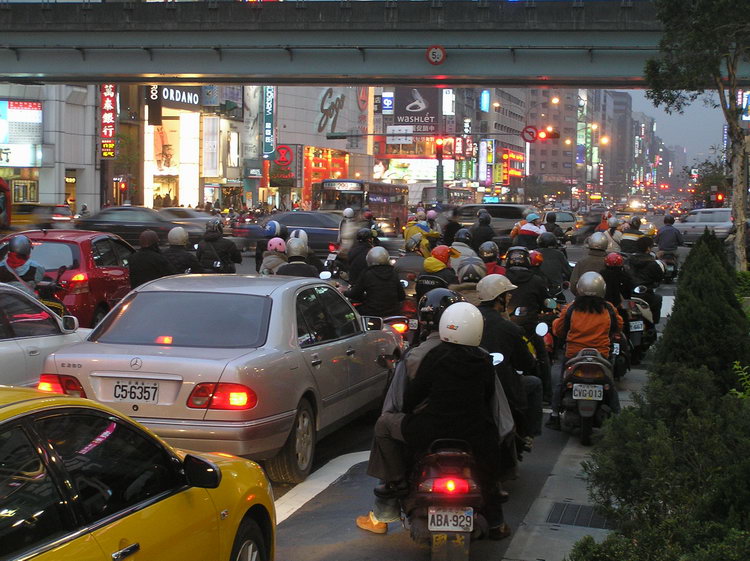
 Barreling down the empty new highway. The speed limit was recently raised to 110 kmph.
 A bridge under construction. Many of Taiwan's smaller bridges are quite beautiful.
 A street dog poses for the camera. Such dogs, hair flaking off and ribs poking out, are a common street sight in Taiwanese cities.
  Protecting a parking space. Locals frequently put out old chairs, baskets, bricks, buckets, and other objects to save their habitual parking spaces. Moving these to park one's own car will result in broken windows and scratched paint, or worse.