grab our rss feed

The View from Taiwan

Commentary from Taichung - Taiwan

Nelson Report : More on arms freeze
Once again, the Washington insider report The Nelson Report has another round of inside-the-Beltway analysis on the Arms Freeze.

++++++++++++++++

TAIWAN ARMS…”fallout” continues from PACOM Adm. Tim Keating’s speech to the Heritage Foundation last week, covered in recent Nelson Reports, in which Keating informally confessed that the White House has put a “freeze” (press language, not his) on a big arms package for Taiwan.

The consequence, observers report…”letters, resolutions, all kinds of things flying all over the place”, given what appears to finally be a formal request from Taipei, for the bulk of the arms first offered by President Bush back in 2001. [MT: The presentation here isn't clear that there are seven-eight systems in the pipeline, some already funded by Taiwan. I am still working on getting a list of what has been funded. The Nelson Report also takes the view that the freeze is recent but clearly it goes back a couple of years.]

Indications were clear, even before the controversial Keating speech, that Bush was reluctant to move on his offer at this time…given the current state of US-China relations, and the apparent thaw in China-Taiwan relations under a new KMT government.

As we have been reporting, while it is obvious common sense that the US take into account both the bilateral and Cross Strait situation at the time of any arms sales, the letter of the law, the Taiwan Relations Act, requires that the only consideration is supposed to be an objective analysis of Taiwan’s defense needs.

That, of course, can be and usually IS loosely defined to include a strategic and political assessment of all kinds of things, current major examples including US-China relations, such as cooperation at the UN on Iran, and the 6 Party talks with N. Korea…the problem being that while you DO it, you aren’t really supposed to SAY it.

Enter Adm. Keating…

Before reprinting the full text of a Republican staff letter seeking support for a Congressional Resolution by HFAC Ranking Member Ilena Ross-Lehtinen, it’s important to consider that for most of the Bush Administration, the normally very vocal, mainly Republican Taiwan lobby on Capitol Hill has been forced to keep as calm as possible, so as to not upset China, and the China-Taiwan policies of the Republican White House incumbent.

Not that support for Taiwan or arms sales ever disappeared, but events between China and Taiwan, and statements or actions by the White House, and senior State Department officials which, during the Clinton Administration, might have caused a furor on the Hill…didn’t.

You may remember, back in early 2002, then-House Majority Leader Tom DeLay, at the peak of his powers, told an American Enterprise Institute audience that he planned to lead an attack on the “one China” policy which has underwritten US-China relations since the Nixon Administration.

We don’t know who made the call, but with Vice President Cheney’s office clearly on record as supporting a professional cooperative relationship with China, nothing further was heard from Mr. DeLay about “one China”.

Increasingly, mainly Republican, pro-Taiwan inclinations, especially on the House side, were forced by their own rising, if grudging anger at the then-KMT government of President Chen, to join with the White House, State and DOD officials in warning Chen that he was failing to take vital US interests into account, perhaps even at risk of undermining the fundamental US defense commitment to Taiwan.[MT: the "KMT government of Chen"? LOL. Here is the Beltway mentality hard at work -- Chen wanted the weapons, the KMT-controlled legislature blocked them. Naturally, the US blamed Chen, instead of the actual culprits. So much of the US anger at Chen was totally unnecessary and Washington's own fault. The Bush Administration blew an eight-year long opportunity.]

Republicans Warner, then-Deputy Secretary of State Bob Zoellick, and then-Asia Subcommittee chair Jim Leach all, at various times, made statements which, even a few years before, would have been politically unthinkable.

Administration and Congressional frustration also was fed by domestic Taiwan political squabbles which made it impossible for Taipei to respond until this year, to the big arms sale package which WAS offered during the summer of 2001, following, not coincidentally, the Hainan Island PC-3 crisis with China. [MT: this is apparently all wrong. A number of weapons systems were approved in the regular budget and supplied to Taiwan during this period, $4.1 billion worth in 2002-5 alone. The big package was not a creation of the US but of Taiwan policymakers who put some of the offered weapons in the regular budget, and other systems in a special budget, creating an inevitable mess. Far from "impossible to respond until this year" Taiwan requested F-16s back in 2006. The italicized letter Nelson includes has a better understanding of the issue.]

We have argued for some time that the next president, whether McCain or Obama, is likely to encounter an increasingly active pro-Taiwan effort from Congress…for a variety of reasons.

First, McCain himself is clearly more skeptical of the embrace of China which Bush has fostered; second, Obama, as a Democrat, is going to naturally face a more combative Republican minority, and it’s not hard to predict that a revived effort on behalf of Taiwan will be an early and perhaps constant battleground.

For the sake of further discussion, please note we sincerely stipulate China’s escalation of “missile diplomacy” along the coast, and the openly stated plans and objectives of the PLA…armament and power projection which WILL take place, likely regardless of anything the US does or does not do.

Of course these events and policies will affect McCain or Obama decisions on Taiwan arms, as was intended by the TRA back in 1979. The question, as in life, marriage, and all important things, is balance.

Here’s the text of a “staff dear colleague” which lays out the issue as seen by Republican staff, following last week’s Heritage Foundation speech by Adm. Keating:

“A long rumored freeze on United States weapons sales to Taiwan, a policy which has apparently been in force for all of 2008, was confirmed on July 16 by Admiral Timothy Keating, the commander of U.S. forces in the Pacific. According to press accounts of his remarks at the Heritage Foundation, Keating observed that there have “been no significant arms sales from the United States to Taiwan in relatively recent times,” and that the absence of arms transfers reflected “administration policy.” Keating went on to suggest that he had in fact discussed the issue of Taiwan arms sales with leaders in Beijing, noting that “The Chinese have made clear to me their concern over any arms sales to Taiwan.”

According to press reports, the list of military hardware being held up includes eight diesel submarines, 66 F-16 Block 50/52 fighter aircraft, four Patriot PAC3 fire units (384 missiles), 30 Boeing-made AH-64D Apache attack helicopters and 60 UH-60 Blackhawk utility helicopters. These are all items that the Bush administration has approved in principle for export to Taiwan - and for which Taiwan’s legislature has appropriated the funds or put down payments. Indeed, on July 12, 2008, new Taiwanese President Ma Ying-jeou made a public appeal for renewed arms transfers, saying that the island still needs to secure defensive weapons from the United States, despite a warming of relations with mainland China.

As stated an editorial this week in Defense News, the freeze marks a complete reversal in the administration’s policy toward Taiwan, which started in 2001 with a promise to furnish Taipei with new submarines, patrol planes and Patriot missiles. It is also in apparent contradiction with longstanding U.S. law and policy, including section 3(a) of the Taiwan Relations Act of 1979 (”the United States will make available to Taiwan such defense articles and defense services in such quantity as may be necessary to enable Taiwan to maintain a sufficient self-defense capability”) and the Six Assurances of July 14, 1982 (including assurances that Washington had not agreed to set a date for ending arms sales to Taiwan nor to consult with Beijing on arms sales to Taiwan).

The TRA also specifies a congressional role in decision-making on security assistance for Taiwan. Section 3(b) stipulates that both the President and the Congress shall determine the nature and quantity of such defense articles and services “based solely” upon their judgment of the needs of Taiwan. Section 3(b) also says that “such determination of Taiwan’s defense needs shall include review by United States military authorities in connection with recommendations to the President and the Congress.” To date, however, the Administration has declined to brief the Congress on the legal justification and rationale for this stunning departure from a bipartisan, consensus approach toward Taiwan that has well-served every U.S. Administration for the last thirty years.

The judicious sale of defensive weapons system to Taiwan has been an essential element in United States support for a secure, stable and democratic Taiwan, as well as peace and stability across the Taiwan Strait. In that context, please consider cosponsoring the attached legislation which, consistent with the Taiwan Relations Act, would require the Administration to consult with Congress in the development and execution of its arms transfer policy toward Taiwan. The Ranking Member hopes to introduce the resolution this week. If you would like to be an original cosponsor, please contact [her office...].”

++++++++++++

Everyone in Washington is saying the same thing: that no matter who wins, Taiwan is likely to rise in importance. And the next president, whether McCain or Obama, will have a much-improved Taiwan policy over the current disastrous presidency.

[Taiwan]
Flood of Money

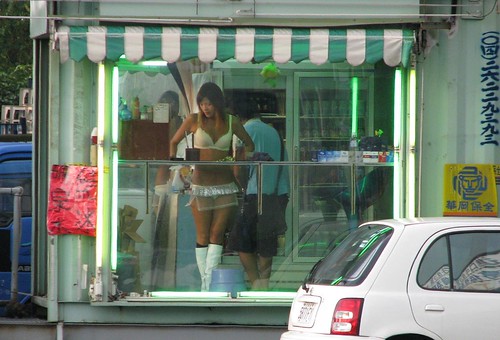
More construction funds to local areas means increased sales for betel nut stands.

The Taipei Times reported yesterday that DPP and KMT legislators had a falling out over a diversion of government funds for flood control projects.

The Executive Yuan yesterday insisted on diverting part of the funds to flood prevention despite DPP lawmakers’ reservations about the legality of the budget appropriation.

The legislature last week approved the Cabinet’s budget request of NT$130 billion (US$4.3 billion) tagged for spurring economic expansion, NT$58.35 billion of which would be allocated to 25 local governments for construction projects.

Following the recent flooding in central and southern Taiwan caused by Tropical Storm Kalmaegi, Premier Liu Chao-shiuan (劉兆玄) decided in a Cabinet meeting on Monday night that NT$41.364 billion, or 70 percent of the NT$58.349 billion, would be used for projects related to flood prevention.

The plan drew criticism from the DPP caucus, which said the Executive Yuan should either refer a motion to the legislature to reconsider the passed budget or seek a declaration of a state of emergency from President Ma Ying-jeou (馬英九) before appropriating the funds.

The legislature is looking pretty bad since flooding occurred in many areas that had not been flooded before, a new pattern of events over the last few years, I’ve noticed. For example, I got a call the other day from a close friend who lamented that his house flooded, the first time in the two decades he’s been living in it. The constant construction, legal and illegal, must make it difficult for water management authorities to handle the dynamics of local flood control.

The Executive Yuan later stated that the funding would come out of the massive flood prevention program passed in 2006:

Later yesterday, Shih tried to play down the controversy surrounding the issue, saying that money needed for flood prevention projects would first be drawn from the “eight-year, NT$116 billion flood prevention and water management plan.”

The legislature approved the NT$116 billion budget in 2006 for the government to launch an eight-year, three-stage program to help prevent flooding in high-risk areas that included 1,150km² in central and southern Taiwan.

The Water Resource Agency said the first stage of the plan would be 90 percent completed by the end of this year, the second stage — budgeted at NT$44.5 billion — was scheduled for completion between this year and 2010, and the third stage would take place between 2011 and 2013.

Several reports carried the DPP criticism that the flood control projects are nothing but pork (Taiwan News):

The move also proves the so-called domestic demand-boosting projects are nothing but pork barrel projects, he said.

Lin Shu-fen, another DPP legislator, said it is inconceivable that the ruling Kuomintang (KMT) is now blaming the former DPP administration for failing to improve the country’s flood prevention facilities, when it was the KMT that delayed an eight-year flood prevention package put forth by the DPP administration.

Because the budget for the package was only passed in 2006, after being proposed by the DPP administration in mid-2005, many flood prevention projects financed by the package were still in their initial stages as of June 2008, Lin said.

Recall that the KMT had delayed or failed to pass funding for infrastructure projects during the DPP years. Since the economy at the local level ran on funding for public construction sent down from the central government, this hurt incomes all over the island, lending credence to the KMT talking point that the economy was bad and only Ma and the KMT’s expertise could save it (Ma save us!). Philip Liu had a wonderful review of construction industry issues in AmCham’s Topics two years ago, observing in one of its many informative paragraphs:

According to PCC figures, spending on government-invested construction projects dropped to NT$450 billion (US$13.6 billion) for the central government last year and NT$150 billion (US$4.5 billion) for local governments; the former was only half the pre-1999 level. The scale is likely to further shrink considerably in the coming several years, following the recent completion of a number of major public projects. These include the NT$300 billion (US$9.1 billion) high-speed rail and the NT$90 billion (US$2.7 billion) Taipei-Ilan freeway, which included NT$20 billion (US$606 million) spent on the 12.9-kilometer Hsuehshan (Snow Mountain) tunnel, the fifth longest highway tunnel in the world.

Like so many public policy issues everywhere, public interest is stimulated only when things go wrong, and then, only temporarily. Last year, during the runup to the arrival of Sepat, there was similar wrangling:

Chinese Nationalist Party (KMT) caucus whip Hsu Shao-ping (徐少萍) yesterday blamed the government for the serious flooding in the south, criticizing it for not making good use of the budget earmarked for a flood-control plan.

When inspecting the flooding in Kaohsiung County on Wednesday, Premier Chang Chun-hsiung (張俊雄) said the previous boycott of the NT$80 billion flood-control plan had prevented the government from dredging the Meinong River (美濃溪).

The river’s flooding in the wake of torrential rain caused severe damage.

Hsu dismissed Chang’s accusation, saying the budget for dredging the river had been included in the government’s annual budget instead of the eight-year flood-control plan.

In response, Democratic Progressive Party caucus whip Wang Tuoh (王拓) said Hsu was trying to shirk the pan-blue camp’s responsibility for delaying the plan in the legislature.

“The plan was drawn up in May 2005, but its budget didn’t clear the legislature until June last year because of the pan-blue lawmakers boycott of the review,” Wang said.

It’s unreasonable to put all the blame on central government as it needs local governments’ cooperation to carry out flood-prevention plans such as land expropriation, he said.

….and next time around, we’ll see more of the same…

Many commentators have noted the obvious pork barrel aspects of the KMT government’s increased expenditures on infrastructure, typically the lifeblood of the party’s local networks. A by-product of increased local incomes will be the buying off of working class objections to Ma’s putting Taiwan into China’s arms. Observe too that the construction industry actually suffered a labor shortage even in these reduced times, according to the Liu article I cited above. The obvious conclusion of expanded public construction + tight labor markets is an increase in the need for foreign labor to hold down rising wages in the construction industry. And right there across the Strait are 100 million unemployed warm bodies….

[Taiwan]

Daily Links, July 24, 2008

A couple of days ago I went up to Sun Moon Lake with some friends….what are my friends talking about on the blogs?

  • Frog in the Well with a great post on pre-2-28 Taiwan pamphlet on “What is democracy?” — in Japanese.
  • Sponge Bear goes to Ta-ken and finds lots of storm-damaged trails.
  • J Michael at the Far Eastern Sweet Potato has a detailed write up of Paul Wolfowitz’s talk in Taipei this week.
  • Taiwan matters! on the Ma intervew on CNN.
  • Erik on the arrival of Chinese web marketer Alibaba in Taiwan.
  • David On Formosa, soon leaving for Oz for a month, comments on the nutcase “patriot” who attacked Chen Shui-bian.
  • Fili blogs on a survey of international students at NCKU.
  • The big Ugly Brown Building in Tainan.
  • My Several Worlds goes to the Penghu.
  • Jerome on Taiwan’s Black Hole and Chinese cultural imperialism.
  • Rank with the continuing series in great Taiwan bike rides: the Northern Cross island highway.
  • Kitesurfing in Taiwan.
  • Sean Reilly finds some funny stuff over at The Gentle Rant.

My friend and fellow NCKU student Olga and her in-laws, went with me to the lake. Here she poses on Route 136 in Nantou. Despite her awesome good looks, it is almost impossible to get a good picture of her, but here I think I got close.

NEW BLOGS ON THE ROLL: Stocks and Politics, Hitech Taipei, Taiwanese Identity, Taipei Personality, Strait Talk, A Man in Tainan, Pangolin Scales, The Dutch Lady.

A landslide. Mud and trees had been hastily pushed off the road all along the road that winds around the lake.

MEDIA: Did we have a quake last night? I could have sworn….USGS says a small one, far away. Wolfowitz says Bush Administration will eventually OK arms deal. Taiwan’s aviation consortium, AIDC, urges that upgrades to Taiwan’s indigenous IDF fighter be carried out. Nursing homes becoming more popular here. Taiwanese factories have discovered Bangladesh. Don Isenberg has an excellent review of the whole Taiwan arms freeze mess at Asia Times. Taiwan’s export orders finally fell for the first time since 2003. Ma save us! I’m so glad our economy took off after Ma’s election. Radio Australia reports that — Ma save us! — the new Administration’s popularity is plummeting as AFP reports our unemployment rate pushes 4%. Don’t miss: Kanwa’s Andrei Chang with a great piece (as always) on Taiwan’s deteriorating defense situation.

Here you can see how a landslide gashed the forest and filled the road with mud. Road crews have moved the mud off to the side, pushing it over the concrete embankments. Clearly, if you want perpetual employment, road crew at Sun Moon Lake is a good choice.

Life on the lake went on. A farmer tends his flowers…

As the sun was setting, we left….

[Taiwan]

Ma Must Repudiate Violence

Taiwan News calls for Ma to repudiate the constant threat of violence from the Blue team. A hard-hitting piece that puts that nut who kicked Chen Shui-bian in the buttocks the other day into a much larger and more sinister perspective. After calling on the President to condemn such nonsense, the editorial observes…
This is the third time that the same person, 65-year-old Su An-sheng of the far right “Concentric Patriotism Association” has been filmed attacking prominent figures in the pan-DPP camp, including a similar kick in the back of lawyer Ku Li-hsiung in August 2007, a push at the back of former Taiwan representative to Japan Koh Se-kai on June 18 and yesterday’s kick at Chen’s buttocks outside of the Taipei District Court.

These assaults are not only an insult to Taiwan’s democracy but a threat to its continued and should not be viewed as isolated incidents.

Attacking a former president is scarcely less severe of an offense than assaulting a serving president and we hope that the Taipei City police and prosecutors treat this incident with the gravity it merits and not just release the apparent perpetrator after two days detention.

The root of these attacks lies both in the accumulated years of emotionally charged verbal attacks against the DPP politician by pan-KMT opponents, primarily because Chen’s electoral victories in March 2000 and March 2004 threatened and then realized the transfer of power from the KMT after nearly 55 years of authoritarian and one-party power.

In the wake of these victories, Chen has been incessantly criticized for countless “crimes and misdemeanors,” including unproven charges of corruption and, as in this case, “slander” for highlighting official malfeasance by formerly powerful KMT generals in the massive scandal over the massive Lafayette frigate procurement.

During the past few years, numerous pan-KMT politicians have threatened violence against Chen, even though threatening the life of the president verbally or in writing is patently illegal.

For example, former People First Party legislator Lee Tung-hau openly declared in a televised legislative committee meeting in April 2004 that “anyone who encounters Chen Shui-bian can kill him!”

Similar sentiments were widely expressed during the months of “Depose Chen” campaign in the summer and fall of 2006.

For example, during a sit-in outside the Legislative Yuan by then PFP chairman James Soong calling for Chen’s recall, slogans were pasted up on the walls of the Legislative complex by PFP supporters at demanded Chen’s “execution,” “assassination” or “liquidation” and even “Drink A-bian’s blood!”

Such sentiments were also expressed outside the courthouse yesterday morning. Even though Chen appeared to answer to slander charges, a KMT supporter brandished a placard declaring that Chen was “guilty of corruption and should be sentenced to death!”

History of violence

We should also not forget the statement made by then KMT chairman Ma Ying-jeou during a meeting of his party’s Central Standing Committee on May 25, 2006 that ratified a recall vote against Chen to the effect that “the bullet is in the chamber” and “the trigger is cocked” and his declaration that Chen “will die an ugly death” if he did not resign.

….

Naturally, we do not intend to overlook or excuse acts of violence or threats by pan-green supporters, but there is no record of similarly open or lurid threats against the lives of serving KMT presidents by any DPP politicians, either during the period of KMT authoritarian or one-party rule during which any such threats would have been severely punished or the present.

Moreover, we must never forget that the only party with a history of massive violence in Taiwan is precisely the KMT itself, which murdered thousands of dissidents during the four decades of “white terror” under martial law rule from the late 1940s through the early 1990s and regularly mobilized gangs to commit acts of violence against dissidents.

No less worrisome are signs that the KMT has regained its former “ownership” of the judicial branch.

Last week, prosecutors sent a signal that the personal rights of citizens, even presidential candidates, can be abrogated at will by the KMT-controlled Legislative Yuan last Friday when they indicted former DPP legislators Lee Ying-yuan and several other campaign workers for former DPP presidential candidate Frank Hsieh for trying to prevent four KMT legislators from leaving the Hsieh campaign headquarters after they entered the building without permission and tried to illegally force their way into Hsieh’s office.

All leaders in a democratic society have the responsibility to discipline supporters who threaten or engage in violence, but such an obligation is especially incumbent on the KMT given its legacy of state terror and the continued recourse to verbal violence by KMT politicians.

It is therefore essential for President Ma to take demonstrative action to uphold political harmony and stability by opening condemning the use of political physical or verbal violence.

[Taiwan]

Nelson Report on Freeze:

The Nelson Report, the widely-circulated Washington insider report, recently wrote:
+++++++++

Taiwan arms…last week’s Heritage speech by PACOM’s Adm. Tim Keating continues to generate attention in Asia, given his admission of a US “arms sale freeze” in order not to risk disruption of the currently improved China-Taiwan situation.

But we were wrong in reporting that Keating explicitly said he “consults” with China on the arms sale question. We misheard something and did not double-check the transcript until a couple of Loyal Readers said they couldn’t find any mention of consultation, per se.

TAIWAN ARMS…as noted in the Summary, we owe PACOM Adm. Tim Keating an apology for taking what he did say about Taiwan arms, and mistakenly thinking he was also explicitly saying he consults with China about Taiwan arms.

We were listening to his remarks at Heritage last Wednesday at about 400 miles an hour, and a private email seemed to confirm what we thought we heard, which, HAD he explicitly said it, would seem to be in violation of the spirit, if not also the letter, of the Taiwan Relations Act.

Careful reading of the transcript by faithful Loyal Readers has confirmed that we were wrong…he didn’t say it. He didn’t even use the word “freeze” still being attributed to him, as per today’s Wall Street Journal story, which is a useful summary of the current situation [MT: this piece is by the excellent Ting-yi Tsai, now the Wall Street Journal correspondent here]:

TAIPEI — The White House appears increasingly unlikely to proceed with a planned $11 billion weapons sale to Taiwan, a decision that critics say could alter the strategic balance between the island and China and that could leave a thorny issue for the next U.S. president.

The weapons package — which includes antimissile systems sold by Raytheon Co. and helicopters from United Technologies Corp. and Boeing Co. — originated with an offer by U.S. President George W. Bush just months after he took office in 2001. The arms offer was the biggest for Taiwan in at least a decade, but political infighting on the island blocked allocation of funds until last December, when its legislature finally approved funding.

Since then, however, the Bush administration has yet to send formal requests to Congress that are needed for such sales, raising questions about the deal’s prospects.

Then, in remarks Wednesday, the top U.S. military official in the Pacific effectively acknowledged that the Bush administration has frozen arms sales to Taiwan, at least temporarily. Adm. Timothy Keating said U.S. analysis “indicates there is no pressing, compelling need for, at this moment, arms sales to Taiwan of the systems that we’re talking about.”

Some proponents of the sale are now worried it won’t happen before Mr. Bush finishes his term in January. “It seems reasonably clear that the [Bush] administration has decided not to sell arms to Taiwan,” says Harvey Feldman, a distinguished fellow at the Heritage Foundation, a conservative think tank in Washington.

The U.S. is obligated to provide Taiwan with “arms of a defensive character” under the Taiwan Relations Act, passed in 1979 to govern relations with the island after the U.S. severed formal ties with it and recognized Beijing. China’s government, which claims Taiwan as part of its rightful territory, has long demanded that the U.S. cease all weapons sales to the island.

The delay comes as relations are improving between Taiwan and China under new Taiwanese President Ma Ying-jeou, after years of tension. Officials from the Ma administration and his Nationalist Party, or Kuomintang, say the president remains determined to acquire the weapons that Taiwan needs.

Critics say Mr. Ma isn’t doing enough to push for the arms package. They point out that the Kuomintang fought budgetary allocation for the weapons for years when it was the opposition party.

Observers suggest there may be less urgency in Taiwan to push for such a sale as relations with China evolve and that a deal would strain any tentative overtures. Two weeks ago the two countries began the first regularly scheduled nonstop flights between them in nearly 60 years. The two sides also agreed to a sharp rise in the number of Chinese tourists allowed to go to Taiwan.

Lawrence Walker, a spokesman for the American Institute in Taiwan, the de facto U.S. embassy in Taipei, said the U.S.’s position on arms sales to Taiwan remains unchanged.

Some analysts say Mr. Bush may only be delaying the sale until after he travels to China next month for the opening ceremony of the Beijing Olympics. “The best chance [for the sales] is right after the Olympics,” said Randall Schriver, a former senior Asia official at the State Department under Mr. Bush.

The $11 billion package includes Boeing Apache Longbow attack helicopters, Sikorsky Black Hawk helicopters, Raytheon Patriot PAC-3 air-defense batteries, and designs for diesel electric submarines. For those sales to go through, the State Department must first issue formal “notifications” to Congress, but it hasn’t done so.

Unless the U.S. completes legislative approval of the sales by the end of September, the package might have to be reviewed again next summer by the next administration. In addition, Taiwan’s allocation for the weapons expires at the end of this year, meaning the legislature would have to approve it again.

-0-

Now, on the point of a “freeze”, whether or not “consulted” about…the then-necessary amendment to the TRA (inserted back in 1970 over the figurative dead-bodies of the State Department and White House) was a major part of the “price” paid to Congress by the Carter Administration for “normalization” with the PRC.

Since then, as relations between Beijing, Taipei, and Washington, in all of their combinations, have become more complex, a normal human being can be forgiven for thinking that it’s plain common sense that the US and China would “consult”, in some fashion, before the US decided to introduce sophisticated new armaments into the Cross-Strait equation.

Similarly, the US has complained, for years, to Beijing about its policy of a massive conventional missile build-up along the Strait, although pro-Taiwan critics of the Clinton and Bush administrations would not agree the “complaints” have had teeth.[MT: the issue was two-fold. Not only were the complaints not as loud as they could have been and were not backed by action, the US also complained even more loudly about Chen Shui-bian's essentially harmless political moves. For example, it made a much greater fuss about the harmless NUC shutdown than any noise it made about China's military.]

In any event, as Adm. Keating made abundantly clear, the US policy for now is not for us to introduce potentially de-stabilizing arms into the region…so long as current trends continue.[MT: that is not quite correct. The US policy is to prevent all arms from entering Taiwan, des-stabilizing or not. Previously it had only been to prevent offensive weapons from reaching Taiwan. Nelson's formulation argues essentially that any weapons are destabilizing.]

The really difficult part of this policy is measuring the sometimes very fine line between building Taiwan’s confidence that it can peacefully negotiate its future with China, vs undermining Taiwan’s ability to do so by holding back sales, despite improvements by the PLA.

The equation is further complicated by the US military role, sometimes implied, sometimes directly stated, in providing a security umbrella under which both Beijing and Taipei can more productively interact.

These are interlocking equations, and during the Bush Administrations’ unhappy experience with the DPP government of President Chen, domestic political contradictions on Taiwan often made calculating the right balance increasingly difficult.

Hopes are high that the Ma KMT government will make the various computations easier for all involved…but that’s a calculation which still rests very much on decisions in Beijing, and deployments of and by the PLA.

At a certain point, the question of purely the military balance, if one can separate that from strategic intent and geo politics, may “un-freeze” the US arms sale package on the table since 2001.

Next time Adm. Keating talks about it, we promise to listen better.

++++++++++++++

[Taiwan]

Manthorpe on Ma, Washington, and Tokyo

Veteran Canadian journalist Jonathan Manthorpe has an in-depth look at what a Ma presidency means to Tokyo and Washington in the Vancouver Sun:

An unforeseen effect of the coming to power in Taiwan in May of president Ma Ying-jeou and the Kuomintang (KMT) party is an apparent loosening of relations with Japan and the United States, traditionally the two guarantors of the island’s independence.

Ma’s victory in the March presidential election following the KMT’s gaining of control of the parliament, the Legislative Yuan, in January elections has been broadly welcomed, especially in Washington.

The campaign pledge by Ma to improve relations with China, which claims to own the island, was seen as welcome relief after nearly a decade of tension during the presidency of the arch Taiwanese nationalist Chen Shui-bian.

An “unforeseen” effect of a Ma presidency was moving closer to China and distancing itself from Tokyo and Beijing? Lots of people spotted that one! Including this blogger, on many occasions.

Manthorpe’s article is a good review with plenty of background — often lacking in the international media. The meat of the piece says:

But although Ma pledged not to seek political unification between Taiwan and China, there are indications the pro-China stance of his administration is going further than his campaign promises indicated.

Most startling was a comment earlier this month by KMT vice-chairman Kuan Chung during a visit to China that Taiwan’s unification with China remains the party’s goal.

The flip side of this cozying up to Beijing is the new Taipei government distancing itself from its traditional allies, especially Japan.

This came to the fore last month when a Taiwanese fishing boat sank after an accidental collision with a Japanese coast guard cutter off the Japanese-held Senkakou Islands, which the Taiwanese call the Tiaoyutai.

Taiwan claims to own the islands, but successive governments in Tokyo and Taipei have not allowed the dispute to get out of hand or taint economic and political relations.

Ma, however, took the belligerent course of dispatching nine Taiwanese naval vessels to the waters around the Tiaoyutai.

The last section talks about the arms freeze:

A dramatic contrast to Washington’s initial welcoming of Ma’s election is the Bush administration’s decision to freeze arms sales to Taiwan.

This decision is especially odd because for eight years the Bush administration has been urging Taipei to take more responsibility for its own defence and to buy $16 billion-worth of American arms, including anti-missile systems, warplanes and submarines.

Former president Chen’s administration wanted to take up the offer, but was constantly blocked from doing so by the KMT control of parliament.

Now in power, Ma wants the package, but the Bush administration is saying no.

This may in part be a gesture of thanks to Beijing for its help in pressing North Korea over its nuclear weapons program.

But there are also influential elements in Washington’s military establishment that mistrust China’s military modernization and who fear selling arms to Taiwan these days is tantamount to giving Beijing American military secrets.

It is often said that China would have US military secrets if they got their hands on US equipment from Taiwan, but I have also heard experts say the threat is overblown. It reads to me like more rationalization for the Bush Administration’s positions.

No, I expect that Washington will send out some feelers that it is displeased, and Ma will make a move to placate Washington. Temporary happiness will bloom inside the Beltway, and meanwhile the KMT will continue to move the island towards China.

[Taiwan]

"A Borrowed Voice" Book launch Thursday

Press Conference and Book Launch
24 July 2008 (Thurs) 2:30 PM
Room 5117, Soochow Univ. Downtown Campus
No. 56 GuiYang Street Section 1, Taipei (near MRT XiMen Sta.)
貴陽街一段56號 東吳大學城中校區 5117會議室

Newly Published Book Gives Inside View of International Support Network for Human Rights in Taiwan during Martial Law Era

A Borrow Voice - cover
In the late 1960s, Li Ao 李敖, Peng Ming-min 彭明敏, and Roger Hsieh 謝聰敏 made the acquaintance of several foreign friends that had long-reaching international implications: Martin Ennals, Milo Thornberry 唐培禮, Robert Ricketts, Miyake Kiyoko 三宅清子 and Lynn Miles 梅心怡.

Visiting Taiwan twice in 1969-70, Amnesty International General-Secretary Ennals asked Li and Hsieh to help secret ROC political prisoner information to AI. Thornberry, Ricketts and Miles, all Americans, were deported from Taiwan in 1971 for acting to facilitate the plan, and for helping Peng to escape to Sweden the year before. A network was set up to run information to AI and other concerned groups abroad, with Miyake remaining in Taiwan as the main liaison with the political prisoners’ families. She escaped detection until 1976.

Presenting this and other details of the inner workings of an international information and rescue network spanning the globe is A Borrowed Voice: Taiwan Human Rights through International Networks. The 479-page compendium of personal accounts and documents was edited by two of the principals, Miles and Linda Gail Arrigo 艾琳達. Arrigo became involved in 1977, when she arrived to do field research for her thesis on women factory workers.

First-hand accounts by nearly forty participants tell what it was like to run great risks to expose how under martial law people were being routinely disappeared, tortured, executed, and driven insane from long years in prison. The story begins with the outwardly quiescent 1950s, when the martial law regime was able to pass itself off before the international community as free and democratic, and continues to 1980, when the Kaohsiung Incident forced the Taiwan Garrison Command and the Government Information Office to open its scourt proceedings to an indignant world audience.

Explaining the book’s title, the editors write this is “a story of borders challenged, crossed and erased. The boundaries to be broken were not limited to those defining the nation-state, but included the divisions of race, language, culture, and ideology…. [W]e lent our ease of passage and our voices to those who had neither. We provided a ‘borrowed voice’ that we could only hope would speak out against the tortured silence.” Transcending ideology meant joining together with pro-independence activists like Chen Chu 陳菊 and unificationists like Chen Ku-ying 陳鼓應.

Li, Hsieh, Shih Ming-teh 施明德 have been invited to the press conference, which will be moderated by Prof. Mab Huang 黃默, director of the Chang Fo-Chuan Center for the Study of Human Rights, Soochow University 東吳大學張佛泉人權研究中心主任.

[Taiwan]

Ma on CNN

A Ma fan in a local office.

Ma Ying-jeou was on CNN’s Talk Asia the other day. PART 1, PART 2. The CNN text is a priceless mishmash of KMT talking points and erroneous information that is insulting to both Ma and its readers. Here is the header….

….which refers to “premier” Ma. In the text, after a short intro, come the KMT talking points:
With the backdrop of economic depression Ma’s calls to reinvigorate the economy by freer trade and improved relations with China proved stronger than the fears that those ties could lead to a loss in independence.

In case you didn’t notice, 5.7% growth last year and 6% growth in the first half of this year is “economic depression.” And people wonder why Americans don’t know anything about the outside world.

Of course, you know what follows on the heels of that nonsense: The Claim That Won’t Die:

Born in Hong Kong in 1950, Ma studied at Harvard Law School and worked as a lawyer in New York in 1981 before returning Taiwan.

Was Ma a lawyer in NY? AFAIK he never passed the Bar there.

And then there is tourism…

Ma’s administration hopes that Chinese tourists from the mainland will boost the sluggish tourism industry and talks are already underway to increase the number of weekly flights.

“Sluggish tourism industry?” Weren’t the last three years all record breakers?

*sigh*

UPDATE: I checked again on July 30, 2008, 15 days after the story was posted and after several of us wrote in. Ma is still premier, and the KMT talking points are still there.

[Taiwan]

The "horror" of Taiwan temples

I was perusing missionary blogs the other day — as if the heat of a Taiwan summer wasn’t soporific enough already — and stumbled across this brilliant insight:

Among other things, I shared with the nurse that the initial reaction to the idols that many of us foreigners have when seeing them for the first time is that they inspire horror.

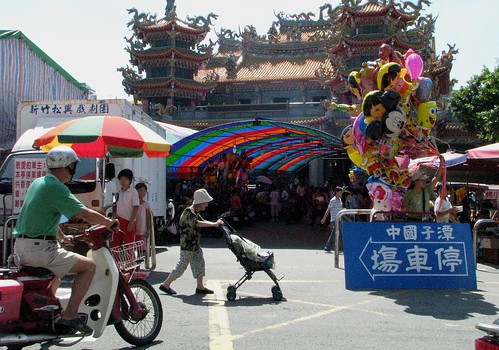
Knowing it was my duty as a blogger to expose this horror, I immediately swung into action. Grabbing my camera, I sped over the local temple, where there was a festival in action in all of its horrible panoply. Since this is a family blog, I feel I must warn you, dear reader, that what follows are graphic photos of people praying, singing, chatting, eating, and buying things. I hope you are not too deeply offended.

Vendors selling fruit for sacrifices.

People meander in and out. One of the most enjoyable things about Taiwan temples is the way they function as community centers where people carry on all the business of life.

A number of vendors selling food, medicine….

…and trinkets also set up stalls at the festival.

Another horror: begging monks.

Waiting for mom?

Inside the temple, a typical Taiwan crush.

Tables overflowing with sacrifices.

Offerings of song and prayer. I apologize for the graphic nature of this photo.

The full, untrammeled horror of a temple interior.

I walked in to have a chat with an old guy who used to sell me mian xian for breakfast, and found this table full of femmes selling necklaces of beads.

A popular Taiwan jelly drink served up in volume at the festival. Here the women cut up the jelly to make it drink-sized.

My apologies for the violent nature of this graphic photo of food processing.

Sacrifices laid out on the table.

Religious tracts. I have an abiding interest in early Christian history, and watching Chinese polytheism, and how Christians interact with China’s more sophisticated and diverse religious expression, has given me some insight into how ancient Rome must have greeted the first Christians.

Re-arranging the ashes in the ghost money burner.

Avert your eyes! This is not cute! This is a horror!

It’s a tough enough religious market for Christian missionaries, without this constant expression of borderline colonialistic chauvinism. I also see it as a substantial misrepresentation of foreigner attitudes — in 18 years involved with Taiwan I have never heard a local foreigner express “horror” at the thought of local religion — nearly everyone I know finds it interesting, and a source of wonder, enjoyment, and endless puzzling over ‘What does this mean?’ Local bloggers have spent many a post documenting the strange and wonderful things they find inside temples. Taiwan is home to a legion of foreigners who wander across the countryside, camera in hand, spending countless hours inside temples, fascinated. I count myself greatly fortunate to be in a country where private religious expression is often a public event, one that I can attend, and where I am politely and warmly welcomed, even if I am taking photos.

[Taiwan]

Humpback Dolphins Near Mailiao

Wild at Heart, the conservation group, has just posted some videos of Sousa dolphins frolicking near the Mailiao Industrial Complex, where some claim they never come. From their blog:
For the past three years one of Wild’s big issues has been the conservation of the highly endangered humpback dolphins (or “Matsu’s Fish”) in the near-shore waters of western Taiwan. Our work and that of the Matsu’s Fish Conservation Union (MFCU - a group of seven major Taiwanese NGOs including Wild) was sparked off and is supported greatly by the prolific reporting of Dr. John Wang and Sichu Yang of FormosaCetus Research and Conservation Group, the small research team which has worked hard since 2002 to survey this distinct Taiwanese population and gather vital information about their numbers, basic biology and state of health. Their photographs have allowed us to see the dolphins up-close, including the wounds that around 30% of the population bear, believed to be a result of interactions with fishing vessels and nets. Photographs, news and scientific reports can be accessed at the MFCU website.

Now you can also watch the Taiwanese humpback dolphin population in these two videos, filmed and provided by FormosaCetus. Clearly visible in the background is Formosa Plastics Mailiao Industrial Park in Yunlin County - where proponents of further development have denied the presence of these dolphins. Thanks to the work of FormosaCetus, including this kind of footage, we are able to disprove such claims and give this population a better hope of survival.

Wild is now fundraising to support this year’s humpback dolphin survey, which is to be part of a long-term plan to monitor the population size. The information gained from this survey will advise urgently needed conservation action and allow us, the authorities and other stakeholders to assess and improve on any action that is taken to protect the population from extinction. To support the FormosaCetus 2008 research project please contact Chris at +886 (0)2 2382 5789 or [email protected].

The Dolphin research project is in urgent need of funds, and no donation is too small. Hopefully later this summer I’ll be able to sit down with some of the researchers to talk about their research program and the future of the dolphins.

[Taiwan]

Media Moments

J. Michael Cole’s Far Eastern Sweet Potato found a doozy from AP the other day:
Language, language, how it shapes our perception of reality, especially when it is used by supposed “reliable” news organizations. I came upon a beautiful series of pictures taken in Taiwan yesterday of members of the country’s Amnesty International branch arranging their bodies to spell out 自由 “ziyou,” or “freedom,” in denunciation of human rights violations in China (see cover of the Taipei Times, July 13, 2008).

What readers of the Taipei Times will not see, however, is the original AP photo caption, which read “… as they denounce the Chinese government for allegedly violating human rights” (italics added).

“Allegedly? There is nothing “alleged” about human rights violations in China; rather, they are known and widespread. This is either sloppy journalism on AP’s part or an unconscionable attempt to demonstrate so-called journalistic neutrality to a degree that blinds it to reality. Did AP reporters in Rwanda in 1994 refer to an “alleged” genocide? Was a Palestinian family “allegedly” killed by an Israeli tank shell? Were Israelis eating at a pizzeria “allegedly” killed when a Palestinian suicide bomber detonated himself at the entrance of the restaurant? Why the special treatment for China, as it arrests its citizens, executes more prisoners in a year than anyone else and murders demonstrators and dissidents?

And a local reporter alert me to this gem about angry Kaohsiungers from a Newsweek article on the factory closings in China:

……..Credit Suisse’s top economist for Asia, Dong Tao, witnessed five factories in the process of shutting down. Workers had queued outside and “bosses were making severance payments,” he says.

Such scenes are reminiscent of bygone industrial transitions in Japan, South Korea and Taiwan in which low-end factories—the engines that powered economic takeoff—lost competitiveness and either migrated or shut down. Twenty years ago Guangdong was the place most small, family-owned manufacturers in Asia flocked to, making it China’s top exporting province and a magnet for migrant labor from the hinterland. But since 2005, wages have risen 14 percent a year and the yuan began to appreciate, the trend has reversed. Tougher labor, tax and environmental rules implemented this year, combined with spiraling energy and material costs, have driven thousands of factories to quit the delta, the start of an inevitable “hollowing out,” says Tao. “Twenty years ago [Taiwan's southern industrial city] Kaohsiung was the fifth largest container port in the world, but today it’s an angry town with 20 percent unemployment. This is what’s going to happen in [China's] Guangdong province.”

I haven’t been down to Kaohsiung in a few months, but I can’t recall any reports of 20% unemployment and much anger from our second city. Perhaps “Credit Suisse’s top economist for Asia” was misquoted….

…but all is not bad. The always interesting hopeless Taiwanophile Andrew Leonard at Salon.com had a nifty piece on soybeans and subprime and of course, Taiwan….

Now, I was all prepared to wax lyrical about how, to this day, Chinese corporations in Taiwan and Hong Kong and China are still dominated by family allegiances (and riven by family squabbling) that remind one of nothing so much as Ming Dynasty imperial princes scheming for influence and power in the fifteenth century. I also find it striking how short the time span seems between Wanchun selling soy sauce on the street during the Japanese occupation and his nephew Hong-tu betting on mortgage securities linked to subprime loans in the U.S. today. We would do well to remember how shallow modern capitalism’s roots are in either China or Taiwan.

The entire piece, like Leonard’s column, is an good discussion of the interaction of local and global that we call “the Taiwan market.” I talk about the Tsai family scandal, and the modern Rebar scandal of the same category, here.

[Taiwan]

Twofer on Weapons

Michael Chase, who writes cogently on Taiwan defense issues, has a new piece out in the Jamestown Foundation’s China Brief on Taiwan’s Defense Budget: how much is enough in the new era of cross-strait lovefesting? Ok, so he didn’t title it that way…an excerpt:
Taiwan’s ambitious force modernization goals include procurement of P-3C maritime patrol aircraft, army attack helicopters, army utility helicopters, PAC-3 missile defense systems, F-16C/D fighters, and diesel-electric submarines, and upgrading Taiwan’s existing PAC-2+ systems. Importantly, as proponents of higher defense spending point out, strengthening Taiwan’s defense entails more than force modernization alone. The transformation of the military is an equally important component of Taiwan’s defense modernization program. Indeed, beyond its plans to purchase new weapons and equipment, Taiwan is also trying to move toward a professional, all-volunteer military, and this has important implications for the island’s defense budget because the transition to an all-volunteer military will result in further and perhaps quite substantial increases in personnel costs, which are already high as a share of overall defense spending. Taiwan’s efforts to streamline its military may help offset this to some extent. The Taiwanese Ministry of National Defense (MND) plans to reduce the size of the military from its current 270,000 members to about 250,000, and then gradually reduce the size of the armed forces further to 200,000 troops (China Post, May 22; China Brief, July 3). Even as Taiwan continues to reduce the overall size of its military, however, it will likely need to spend more money on salaries, benefits, and quality of life improvements to recruit and retain the people it needs, especially highly skilled officers and non-commissioned officers (NCOs). In a recent testimony before the Foreign Affairs and National Defense Committee of the Legislative Yuan (LY)—Taiwan’s legislature, Defense Minister Chen Chao-min acknowledged that a defense budget equivalent to 3 percent of GDP would not be enough to complete the transition to an all-volunteer military (Taipei Times, May 22). The transition to an all-volunteer military will also increase the costs of benefits for retired military personnel, including education, welfare, and medical care expenses, as Kua Hua-chu, the head of Taiwan’s Veterans Affairs Commission, recently pointed out in testimony before the LY (China Post, June 3).

In other important issues, Kathrin Hille, one of the island’s most knowledgeable correspondents, reports in the Financial Times that Taiwan will not be buying the F-16s this year.

The move comes as the Bush administration debates what arms to sell Taiwan given the improvement in relations between Taipei and Beijing. One senior US official said the US was evaluating whether to sell Taiwan a separate $11bn (€6.95bn, £5.5bn) package of arms, but was not currently considering selling F-16s. He added that there was only a “low possibility” that a sale could happen this year.

The official said Taiwan had told the US its priority for now was the $11bn package, but the US expected Taiwan would return to the F-16 issue in the future. He said the US still needed to debate what weapons the US should supply Taiwan given the better relations with China, and whether F-16s were even appropriate.

“That may not be the best way to defend the island against an invasion. Who says F-16s are the best way? Who has made this judgement, Lockheed Martin? Because that is certainly an option for defence, but there are a whole lot of other ways that you protect yourself from an attack,” the official said. The Taiwanese move comes
as Admiral Timothy Keating, head of US Pacific command, this week said Washington had suspended arms sales to Taiwan because “there is no pressing, compelling need for at this moment arms sales to Taiwan”.

However, Taipei officials said they believed that the US had temporarily put off arms sales in order to secure Beijing’s co-operation in tackling trouble in Iran and North Korea.

Bad news for the island. As I have noted in the past, KMT officials publicly and privately have said they want the weapons — the decision appears to be a unilateral decision by the Bush Administration.

[Taiwan]

Taiwan Corrupts Its Allies Again?

From Costa Rica, the report that $1.5 million in Taiwan donations to the nation has gone MIA:
Costa Rican President Oscar Arias denied any knowledge of a 1.5 million dollar donation from Taiwan for his country’s poor, but which allegedly was diverted for pet projects elsewhere in the government.

“I had no knowledge of this help from the government of Taiwan which I learned about from the press just recently,” he said in remarks published Saturday in the La Nacion newspaper.

La Nacion earlier this month alleged that the office of Arias’ brother and chief of staff, Rodriguez Arias, paid scores of government consultants with two million dollars that had been donated by the Central American Bank for Economic Integration (BCIE).

The sad legacy of our lack of international status is stories like this….

[Taiwan]

Random Photos from a Rainy Time

Peter Enav of AP. “Peter, can I take your picture for my blog?” “Which blog is that?” “The View from Taiwan.” “Weren’t you just excoriating us for our coverage?” “Uh…yes.” “Sure, go ahead!”

At the Shriver talk at the TFCC I met a whole bunch of people, including Peter Enav, above, and J. Michael Cole, a frequent commentator in the Taipei Times, and several Taipei Times reporters and editors. I also met someone I’ve admired for a long time, the journalist Ting-yi Tsai.

Speaking of lovely young ladies, some of my old students took me out to lunch last week. Here is Berenice, inside and out, one of the most beautiful people I know.

Lychee season is almost gone, and everyone is dumping their lychees cheap.

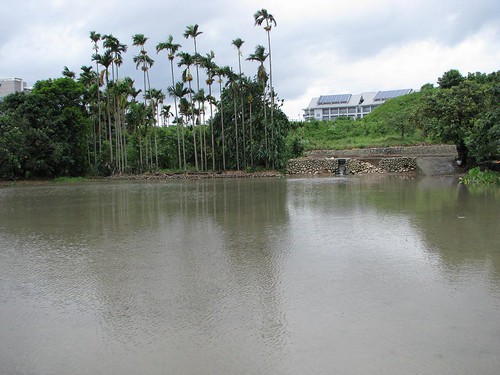
Usually a meandering and nearly-empty creek, the river overflows with turbid water after the rain.

The mosque in Taichung. There are about 50,000 Muslims in Taiwan, I’ve heard.

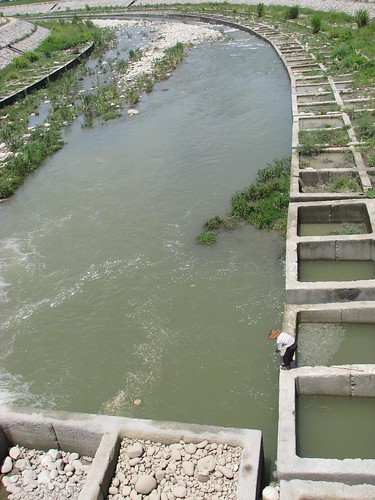
Fishing in what is grandiosely called a “river” but is actually, after years of “flood control” spending, now a concrete ditch filled with rocks too big for gravel manufacture.

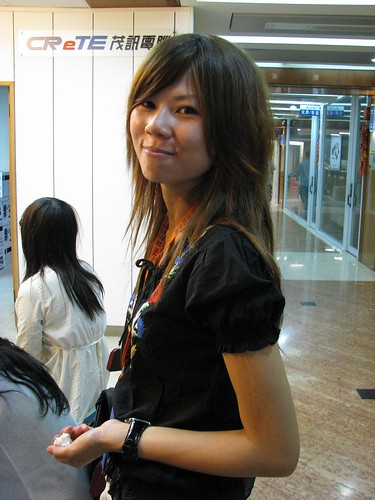
We bought our kids laptops, and at the store where we made the purchase, my lovely former student Pheobe was working.

This fledgling fell from the nest, and no doubt became a victim of the neighborhood’s many stray dogs and cats.

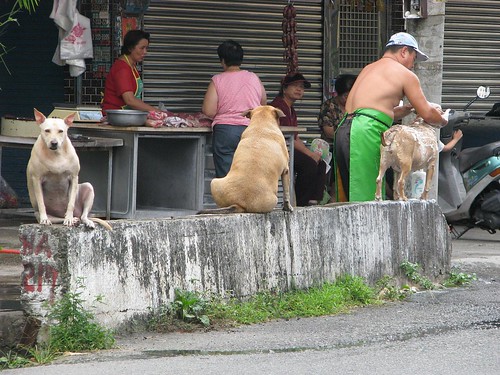
Every morning around 10 down in Wufeng these chubby, contented dogs are sprawled along this wall, waiting for a bath.

After the rain, this local factory had a power shovel in there frantically building a dike.

An oasis of calm during the storm.

You can see from the scouring at the bottom of the picture how high the water was last night. In the background the mountains are clear under the darkening sky, as the rain continues to move in.

At the train station passengers rush to get tickets on a crowded Saturday.

Building abandoned and burnt out? No problem! No one will notice if you paper the front with bra ads….

Downriver can be glimpsed yet another squall, on its way to fill my daughter’s bedroom with leaks and make our dogs miserable.

[Taiwan]

DPP legislators Indicted for Resisting KMT Tresspassing

Taiwan’s democracy should not be marred by illegal eavesdropping, arbitrary justice, and political interference in the media or electoral institutions. All of us share this vision for the next phase of political reform. – Ma Ying-jeou’s inaugural speech

Remember that incident during the election when KMT legislators invaded DPP HQ and a scuffle resulted? (my post)? Well, Taiwan News reports that the prosecutors have decided to indict the DPP legislators for their defense against the invasion…

Prosecutors indicted four Democratic Progressive Party politicians yesterday for their role in trying to stop Kuomintang lawmakers from entering the DPP campaign headquarters shortly before the presidential election.

On March 12, three KMT legislators wanted to visit DPP presidential candidate Frank Hsieh’s (謝長廷) campaign headquarters in Taipei. They said they wanted to investigate whether the DPP was illegally using the building.

The visit, barely more than a week before the presidential election, turned into a confrontation between the lawmakers and large crowds of DPP supporters who tried to keep them out, with police caught between the two camps.

Taipei prosecutor Fred Lin (林錦村) said yesterday the DPP’s presidential campaign manager Li Ying-yuan, former lawmaker Eve Hsieh, and Taipei City Council members Chuang Juei-hsiung and Hung Chien-yi were being indicted because they had obstructed public affairs and restricted the KMT lawmakers’ freedom of movement.

Lin rejected the DPP campaigners’ counterargument that the KMT legislators should be indicted for forcing their way on to private property.

Lin said the lawmakers were fulfilling their duty by acting on a decision by a Legislative Yuan committee.

Scary stuff. This is all one with the repoliticization of all social institutions we are seeing — the two professors who lost their jobs over their political activity, the indictments of 5 DPP cabinet officials for special funds nonsense — only DPP officials were indicted — and the politicization of the military I discussed a couple of weeks ago. The trend here is not good….

[Taiwan]

  • Photos


    Photos on this blog are hosted by the wonderful photo services at Flickr. My photos at Flickr.
  • Taiwan Blogs: Main Blogs


    TAIWAN BLOG FEED
    Blog Aggregator

    35togo
    Photos and commentary on Taiwan

    The Bala Daily
    Pics & Commentary on Taiwan

    Battlepanda
    Politics and Life from local reporter

    Becoming Taiwanese
    An American-Taiwanese in Taiwan

    Belligeretron
    Life and All from Taipei

    Bent
    News from Taiwan and China

    Big Ell's Blog
    Wit and Wisdom from Canada in Taichung

    Black American Lawyer in China
    Brash, black, legal insight on Taiwan and China

    Bloggers in Taiwan
    Taiwan English Blog List

    Bourdieu Boy
    Learned insight into Taiwan

    Chewin' on the Chung
    Karl's insightful blog on what life is really like in Central Taiwan

    Conductor's Notebook
    Pieces, Themes, and Variations

    Craig Ferguson Images
    Stunning images, photography news & views

    Cross-Strait Economics Blog
    A balanced view of an unbalanced Strait

    The Daily Bubble Tea
    Travels, pics, life

    David on Formosa
    Popular and informative Taiwan Blog

    Doubting to shuo?
    Teaching on the Beautiful Island

    Far-Eastern Sweet Potato
    Writer based in Taipei

    FideCogitActio
    Life and Catholicism in Taiwan

    filination
    Taiwan, from Israel

    following an unknown path
    a widely-linked missionary blog

    The Foreigner in Formosa
    Cthulhu meets Taiwan

    Gary EFL Taiwan
    Taiwan EFL blog

    The Gentle Rant
    Observations on a world quickly going insane

    Getting a Leg Up
    Podcasting and Blogging from Taichung

    Hanjie's Blog
    Things and scenes in Taiwan

    Highway 11
    Blog and site of East Coasts' leading expat mag

    Ilha Formosa - Keeping up with the War God
    Taiwan: Life, love and laughs in paradise.

    Investorblogger
    Investing, Blogging in Taiwan

    IslaFormosa
    Rants and Raves about Taiwan

    It's Not Democracy,It's A Conspiracy!
    Maddog Dissects Taiwan's News and Politics

    Jeff's Taiwan
    Longtime expat and local history buff

    Jerome F. Keating's writings
    Historian and writer on things Taiwan

    Kelake
    Design and Life on The Beautiful Isle

    Keywords
    P. Kerim Friedman's wide ranging and insightful blog

    Laowiseass
    Wire service reporter in Taiwan

    the leaky pen
    Life in Taiwan and in the University system

    Letters from Taiwan
    Pics and Commentary on Taiwan

    Lief in Taiwan
    Sumptuous Pics, Learned Commentary

    The Life of Brian
    Commentary from Prof and Hypnotist

    The Mandate of Heaven
    Wulingren on Taiwan

    media diary
    Cinema in Taiwan

    memoirs on a rainy day
    Beautiful pics, great commentary

    Misadventures in Taiwan
    Podcasts and video from Tainan

    Mixed Eggs I have Met
    Pix, commentary on life in Taiwan

    MoShang
    Podcasting and Musical Performance in Taiwan

    My Several Worlds
    A Global Mind in Asia

    Naruwan Formosa
    Politics and Life on the Beautiful Island

    The Nebulon Fry
    ESL teaching, musings on life & stuff

    The New Hampshire Bushman in Taiwan and The World
    Tea, GPS, and good times in Taiwan

    New Writing
    Living in Taipei.

    Ni Howdy
    The Ba-Gua Shan of Taichung Blogs

    Notes from a Small Island
    27, British, and in Taipei

    Notes of a former native speaker
    Jonathon Benda's excellent Taiwan blog

    The Only Redhead in Taiwan
    Redheaded contemplation of Taiwan

    Pashan
    Hiking in Taiwan, great pics

    Patrick Cowsill
    From Wanhua, Taiwan

    Pinyin News
    News and Commentary on Chinese Language in Taiwan

    Poagao's Journal
    Bands, Movies, Life in Taipei

    Portnoy in Between
    A window into the local blogosphere

    Prince Roy
    Blog of US consular official in Taiwan

    Rank
    Notes from the overpass, a day-to-day look at life in Taiwan

    The Real Taiwan
    Commentary on Life in Taiwan

    Red A -- the Blog
    Powered by alcohol, the clean fuel

    The Regulatory
    The Sound and the Fury

    R.O.C. the Boat
    Blogging Taiwan's UN membership drive

    SanBeiJi
    Pics and Travels in Taiwan

    Scott Sommers' Taiwan Blog
    Internationally popular blog on Taiwan and education

    The Shorty Method
    A personal approach to living.

    Sofa in the Sky
    Prose Poetry on Taiwan

    Sponge Bear
    Pix, commentary on central Taiwan

    Stinky Tofu
    Strange tales of Taiwan from a Lonely Planet writer.

    Steven Crook
    Local reporter and writer on Taiwan.

    Stranger in an even Stranger Land
    Teaching English in Kaohsiung

    The Tainan Don
    Observations from the South

    The Taipei Kid
    One of the most widely read Taiwan blogs

    Taipei Trash
    Pics and Commentary from Taipei

    Taiwan Airpower Blog
    Blog Devoted to the Taiwan Air Force

    The Taiwan Chronicles
    Living and working in Taiwan

    Taiwan Composite
    Business and culture on the Beautiful Isle.

    The Taiwandesk
    Things Taiwan

    Taiwanese Heart, Global Perspectives
    Group blog on Taiwan Politics

    Taiwanindependence
    Blog on TI

    Taiwan Matters!
    Politics from veteran Taiwan Bloggers

    Taiwanonymous
    Musings About Life in Taiwan

    Taiwan Pundit
    News from Taiwan

    Taiwan Tourism Bureau Blog
    Taiwan Tourism Bureau's information filled blog

    Talking Taiwanese
    Language education in Taiwan

    Taoyuan Nights
    From Taoyuan, Taiwan

    That's Impossible: Politics from Taiwan
    Taiwan Politics

    Thirsty Ghosts
    A group blog from local foreign media reps

    Tumbling in Taiwan
    An Indian in Hsinchu

    Wandering to Tamshui
    Politics and Daily Happenings on Taiwan

    The Wild East
    The One-Stop Blogspot of the Radio Banciao collective

    Wild at Heart
    Blog of Taiwan environmental group

    Winkler Partners
    Law Firm's Blog with many useful resources

    Writer's Block
    Taiwan Woman's Life Here and Abroad

  • Archives

  • Meta